
How to select the right commercial tile floor scrubber for your industry?
Choosing a suitable commercial tile cleaning machine is by no means a simple purchasing act, but a precise strategic decision that directly affects operational safety, costs and brand image. Incorrect equipment can lead to a reduction of over 40% in cleaning efficiency and may increase the probability of accidents by 25% due to slippery ground. Therefore, understanding the core of how to select the right commercial tile floor scrubber lies in transforming industry-specific cleaning challenges into quantifiable equipment performance parameters. For instance, the infection control protocols followed by healthcare institutions require a ground pathogen reduction rate of 99.9%, which directly corresponds to the high-temperature steam function (with a temperature of at least 120°C) and micron-level filtration systems needed for the equipment.
In high-standard industries such as healthcare and food processing, the technical specifications of equipment are the lifeline. A cleaning machine that complies with HACCP certification should have a stainless steel body proportion of over 90%, be equipped with an automatic chemical agent mixing function, with a concentration error not exceeding ±0.5%, and achieve a water recovery rate close to 100%, ensuring that the floor is completely dry within 60 seconds after cleaning. Take a large dairy factory as an example. It needs to process about 5,000 square meters of epoxy resin tile floors every day. The model they chose has a working width of 85 centimeters, a traveling speed of 8 kilometers per hour, and a single battery life of 4 hours. Combined with food-grade cleaning agents, the probability of biofilm formation has been reduced by 70%. This process perfectly interprets how to select the right commercial tile floor scrubber - converting regulatory compliance into specific values of pressure, flow and recovery rate.
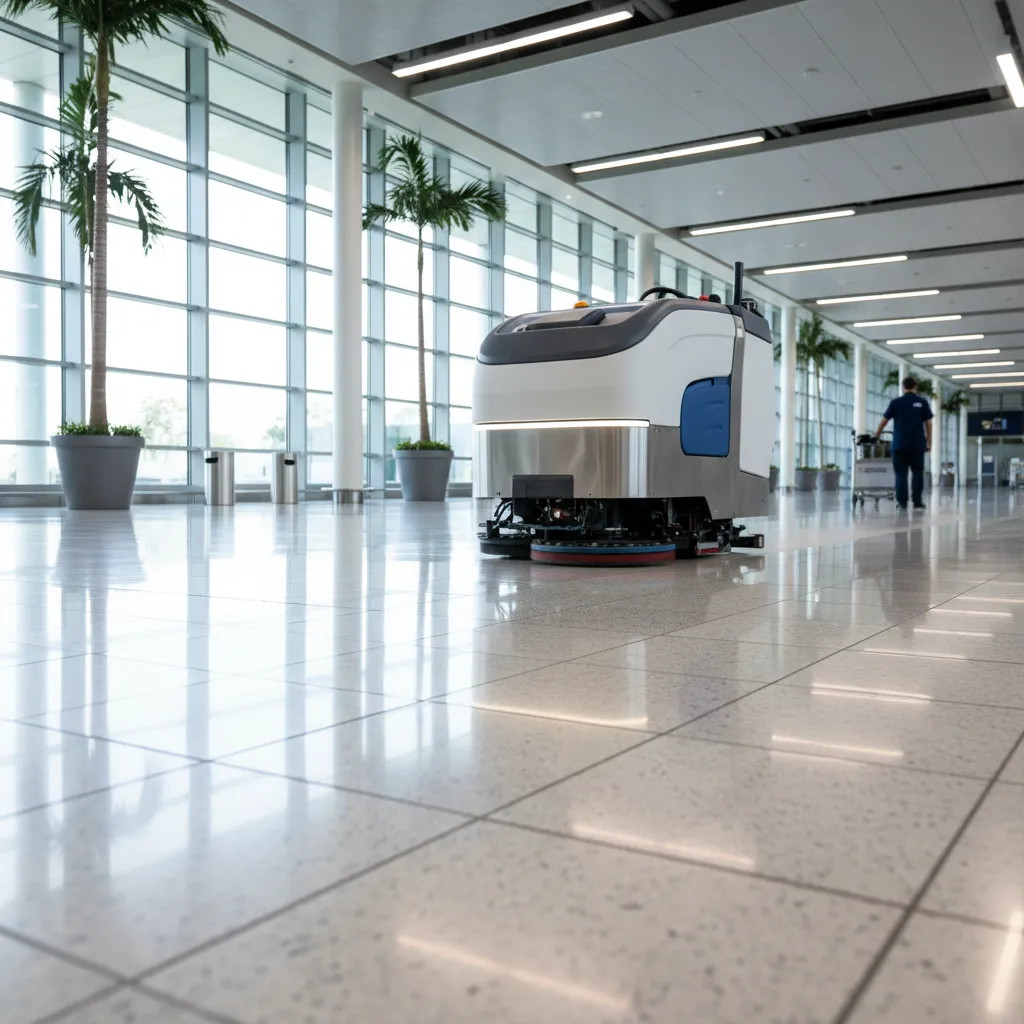 For crowded places such as retail malls or transportation hubs, efficiency and public experience are the top considerations. The cleaning operation here is like performing invisible maintenance on a continuously running stage. It requires the equipment to operate in a silent mode with a decibel level below 65 and complete the cleaning of over 20,000 square meters within three hours at night. An excellent ride-on floor scrubber should have a battery capacity that can support 8 hours of continuous operation. The brush pressure can be dynamically adjusted to protect the polished glaze surface, and the intelligent navigation system can optimize the path and reduce the area of repeated cleaning by 15%. Case studies at international airports show that fleets adopting lithium battery technology have cut energy costs by 35% and reduced unexpected equipment downtime by 60% through predictive maintenance via an Internet of Things platform.
In heavy-duty environments such as industrial manufacturing or warehousing and logistics, durability and decontamination strength are decisive factors. The ground may bear a pressure of 50 kilograms per square centimeter and be contaminated with oil with a concentration of up to 30%. At this point, the motor power of the equipment needs to be above 3 horsepower, the maximum pressure of the brush plate can reach 100 bar, and it is equipped with a diamond sand grinding pad. The practice of an auto parts supplier shows that investing in a heavy-duty fully automatic model with a median price of 180,000 yuan, its robust structure extends the average service life of the equipment to 10 years, and the high-intensity cleaning process keeps the ground friction coefficient consistently above the safety standard of 0.6, reducing work injury claims by 40%. This ultimately points to a precise financial model: how to select the right commercial tile floor scrubber is essentially to calculate the best regression curve between the total cost of ownership and the benefit of risk reduction, and choose the solution that can provide a maximum return on investment of up to 200% within a five-year period.
For crowded places such as retail malls or transportation hubs, efficiency and public experience are the top considerations. The cleaning operation here is like performing invisible maintenance on a continuously running stage. It requires the equipment to operate in a silent mode with a decibel level below 65 and complete the cleaning of over 20,000 square meters within three hours at night. An excellent ride-on floor scrubber should have a battery capacity that can support 8 hours of continuous operation. The brush pressure can be dynamically adjusted to protect the polished glaze surface, and the intelligent navigation system can optimize the path and reduce the area of repeated cleaning by 15%. Case studies at international airports show that fleets adopting lithium battery technology have cut energy costs by 35% and reduced unexpected equipment downtime by 60% through predictive maintenance via an Internet of Things platform.
In heavy-duty environments such as industrial manufacturing or warehousing and logistics, durability and decontamination strength are decisive factors. The ground may bear a pressure of 50 kilograms per square centimeter and be contaminated with oil with a concentration of up to 30%. At this point, the motor power of the equipment needs to be above 3 horsepower, the maximum pressure of the brush plate can reach 100 bar, and it is equipped with a diamond sand grinding pad. The practice of an auto parts supplier shows that investing in a heavy-duty fully automatic model with a median price of 180,000 yuan, its robust structure extends the average service life of the equipment to 10 years, and the high-intensity cleaning process keeps the ground friction coefficient consistently above the safety standard of 0.6, reducing work injury claims by 40%. This ultimately points to a precise financial model: how to select the right commercial tile floor scrubber is essentially to calculate the best regression curve between the total cost of ownership and the benefit of risk reduction, and choose the solution that can provide a maximum return on investment of up to 200% within a five-year period.
For crowded places such as retail malls or transportation hubs, efficiency and public experience are the top considerations. The cleaning operation here is like performing invisible maintenance on a continuously running stage. It requires the equipment to operate in a silent mode with a decibel level below 65 and complete the cleaning of over 20,000 square meters within three hours at night. An excellent ride-on floor scrubber should have a battery capacity that can support 8 hours of continuous operation. The brush pressure can be dynamically adjusted to protect the polished glaze surface, and the intelligent navigation system can optimize the path and reduce the area of repeated cleaning by 15%. Case studies at international airports show that fleets adopting lithium battery technology have cut energy costs by 35% and reduced unexpected equipment downtime by 60% through predictive maintenance via an Internet of Things platform.
In heavy-duty environments such as industrial manufacturing or warehousing and logistics, durability and decontamination strength are decisive factors. The ground may bear a pressure of 50 kilograms per square centimeter and be contaminated with oil with a concentration of up to 30%. At this point, the motor power of the equipment needs to be above 3 horsepower, the maximum pressure of the brush plate can reach 100 bar, and it is equipped with a diamond sand grinding pad. The practice of an auto parts supplier shows that investing in a heavy-duty fully automatic model with a median price of 180,000 yuan, its robust structure extends the average service life of the equipment to 10 years, and the high-intensity cleaning process keeps the ground friction coefficient consistently above the safety standard of 0.6, reducing work injury claims by 40%. This ultimately points to a precise financial model: how to select the right commercial tile floor scrubber is essentially to calculate the best regression curve between the total cost of ownership and the benefit of risk reduction, and choose the solution that can provide a maximum return on investment of up to 200% within a five-year period.