
Why Are Dental CAD/CAM Milling Burs With Coated Designs Better for Lab Productivity?
Dental CAD/CAM milling drill bits with coating design can extend the tool life by an average of 80% to 1,000 hours, directly increasing the production capacity of a single drill bit by more than 3,000 restoration units. This means that for laboratory capacity planning, the frequency of tool procurement can be reduced by 50% annually. For instance, the renowned Glidewell Laboratory in the United States pointed out in its 2023 productivity report that after fully switching to the diamond-coated design of dental cad/cam milling burs, its tool replacement cycle was extended from three weeks to eight weeks, saving 15% of tool management time in a single month. The nanometer-level thickness of this coating is usually only 3 to 5 micrometers, yet it can withstand temperatures over 1,200 degrees Celsius, reducing the friction coefficient during the cutting process by 40%, just like covering the drill bit with a solid ceramic armor.
In terms of enhancing processing efficiency, coated drill bits can increase the milling feed rate by 20%. For instance, the processing time for a zirconia full crown is reduced from 18 minutes to 14.5 minutes, which boosts the daily output of a single machine by more than 15 units. An industry white paper released by the Swiss Straumann Group shows that the dental cad/cam milling burs coated with titanium nitride can maintain the sharpness of the cutting edge for 2.5 times longer than uncoated drill bits in continuous operation, and the accuracy deviation caused by tool wear is controlled within ±0.015 millimeters. This stability enables the laboratory to reduce the scrap rate from 5% to below 1% when dealing with high-hardness materials such as lithium disilicate, which is equivalent to recovering over 2,000 US dollars in material losses for medium-sized laboratories each month.
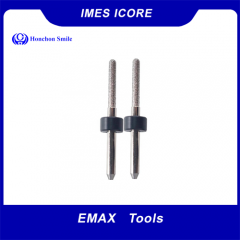 From a cost-benefit analysis perspective, although the initial procurement cost of coated drill bits is 25% higher, the comprehensive benefits they bring reduce the processing cost of each restoration by more than 30%, and the payback period is usually less than six months. Referring to the practical case of the large-scale machining center "Modern Dentistry" in Asia, after introducing the dental cad/cam milling burs with diamond-like carbon coating design, the annual tool budget was reduced by 18%, while the equipment utilization rate increased by 22%, because the excellent chip removal design of the coating reduced the cleaning and maintenance time by 70%. This coating technology stabilizes the processing temperature below 50 degrees Celsius by rapidly conducting the cutting heat away from the workpiece surface, avoiding the risk of material phase transformation and ensuring a clinical fit rate of up to 99.8% for the restoration.
The innovative design of the coating has also significantly enhanced process compatibility. For instance, the multi-layer gradient coating can simultaneously adapt to 12 different hardness materials ranging from pre-sintered zirconia to PMMA temporary materials, reducing tool change calibration time by 60%. According to a 2024 study in the International Journal of Computerized Dental Medicine, laboratories using advanced coated drill bits have seen a 15-percentpoint increase in overall equipment efficiency, similar to the engine efficiency leap in the automotive industry brought about by the adoption of low-friction coated pistons. This technological innovation has directly translated into a competitive edge for the laboratory, enabling it to deliver complex restorations within 24 hours. Patient satisfaction surveys show that the quality score has jumped from 4.2 to 4.8.
From a cost-benefit analysis perspective, although the initial procurement cost of coated drill bits is 25% higher, the comprehensive benefits they bring reduce the processing cost of each restoration by more than 30%, and the payback period is usually less than six months. Referring to the practical case of the large-scale machining center "Modern Dentistry" in Asia, after introducing the dental cad/cam milling burs with diamond-like carbon coating design, the annual tool budget was reduced by 18%, while the equipment utilization rate increased by 22%, because the excellent chip removal design of the coating reduced the cleaning and maintenance time by 70%. This coating technology stabilizes the processing temperature below 50 degrees Celsius by rapidly conducting the cutting heat away from the workpiece surface, avoiding the risk of material phase transformation and ensuring a clinical fit rate of up to 99.8% for the restoration.
The innovative design of the coating has also significantly enhanced process compatibility. For instance, the multi-layer gradient coating can simultaneously adapt to 12 different hardness materials ranging from pre-sintered zirconia to PMMA temporary materials, reducing tool change calibration time by 60%. According to a 2024 study in the International Journal of Computerized Dental Medicine, laboratories using advanced coated drill bits have seen a 15-percentpoint increase in overall equipment efficiency, similar to the engine efficiency leap in the automotive industry brought about by the adoption of low-friction coated pistons. This technological innovation has directly translated into a competitive edge for the laboratory, enabling it to deliver complex restorations within 24 hours. Patient satisfaction surveys show that the quality score has jumped from 4.2 to 4.8.
From a cost-benefit analysis perspective, although the initial procurement cost of coated drill bits is 25% higher, the comprehensive benefits they bring reduce the processing cost of each restoration by more than 30%, and the payback period is usually less than six months. Referring to the practical case of the large-scale machining center "Modern Dentistry" in Asia, after introducing the dental cad/cam milling burs with diamond-like carbon coating design, the annual tool budget was reduced by 18%, while the equipment utilization rate increased by 22%, because the excellent chip removal design of the coating reduced the cleaning and maintenance time by 70%. This coating technology stabilizes the processing temperature below 50 degrees Celsius by rapidly conducting the cutting heat away from the workpiece surface, avoiding the risk of material phase transformation and ensuring a clinical fit rate of up to 99.8% for the restoration.
The innovative design of the coating has also significantly enhanced process compatibility. For instance, the multi-layer gradient coating can simultaneously adapt to 12 different hardness materials ranging from pre-sintered zirconia to PMMA temporary materials, reducing tool change calibration time by 60%. According to a 2024 study in the International Journal of Computerized Dental Medicine, laboratories using advanced coated drill bits have seen a 15-percentpoint increase in overall equipment efficiency, similar to the engine efficiency leap in the automotive industry brought about by the adoption of low-friction coated pistons. This technological innovation has directly translated into a competitive edge for the laboratory, enabling it to deliver complex restorations within 24 hours. Patient satisfaction surveys show that the quality score has jumped from 4.2 to 4.8.